The Maliau Basin camps
Set expectations correctly and the trek is excellent. Do not, and it is a shock. The interior camps provide a bed and a pillow. That is the complete list of what is provided.
Dormitory shelters with a bed and a pillow — no blanket, towel, power or hot water. Nepenthes Camp (formerly Camel Trophy Camp) sits at 945 m; Ginseng Camp at 645 m, a short walk from swimmable Ginseng Falls. Agathis Camp is the trailhead, not slept in. Belian Camp sits near the Studies Centre, outside the trekking loop. Cooks travel with the group and meals are included.
Bring a sleeping bag, quick-dry towel and a battery head torchThe four Maliau Basin camps
| Camp | Elevation | Role | Type |
|---|---|---|---|
| Agathis Camp | Trailhead | Start and finish of the loop | Transit |
| Nepenthes Camp | 945 m | First night on the trek | Dormitory |
| Ginseng Camp | 645 m | Second and third nights | Dormitory |
| Belian Camp | Near the Studies Centre | Outer facility, not on the loop | Camp |
Only Nepenthes and Ginseng are slept in on the standard trekking itineraries. Agathis is where you leave the vehicle and start walking. Belian sits outside the loop entirely.
 img/camps-hero.jpgInterior camp shelter in the forest21/9
Agathis Camp
Agathis is where the road ends and the trek begins. Groups transfer here from the Studies Centre after breakfast on the first trekking morning, and return here on the final day to meet the driver.
The camp takes its name from the Agathis conifers that dominate the lower montane forest above it. From Agathis the trail climbs steeply across the southern basin rim toward Nepenthes, and that climb is the hardest sustained section of the entire loop.
You do not normally sleep at Agathis. It functions as a trailhead and a transition point, where you clean up on the way out before the long road journey.
Nepenthes Camp
The highest camp on the loop, and the first night out. Nepenthes was formerly known as Camel Trophy Camp, a name that still appears in older trip reports and on some maps, so do not be confused if your research turns up both.
The name it carries now is the better one. The camp sits in montane heath forest where pitcher plants of the genus Nepenthes grow thickly in the poor, acidic soil. At least six species have been recorded along the trail approaching it, alongside rhododendrons and wild orchids.
At 945 metres, nights here are noticeably cooler than at the Studies Centre or on the coast. This is the camp that makes a light jacket worth carrying in every month of the year.
What is nearby
On the five-day itinerary, an optional two to three hour return walk reaches Takob Akob Falls, a 38 metre drop and the tallest waterfall in the basin. On the four-day itinerary the afternoon side trek goes instead to Giluk Falls, about 3 kilometres each way.
Ginseng Camp
The second camp and, on the five-day itinerary, the base for two nights rather than one. That matters more than it sounds: it is the only point on the trek where you unpack once and stay put.
Ginseng sits 300 metres lower than Nepenthes, which is why the leg between them feels easier than the climb up from Agathis, and why the final day back out to Agathis is more work than the distance alone suggests.
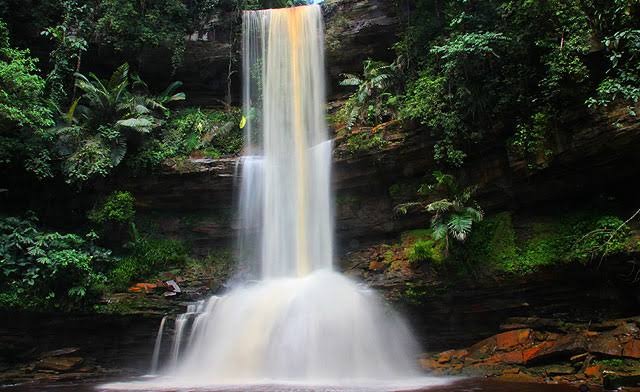
Ginseng Falls is a short walk from camp and swimmable, which after two days of walking in constant humidity is a considerable thing. Maliau Falls, the seven-tiered cascade that is the basin's signature sight, is reached from here — an out-and-back of 4.5 kilometres each way on the five-day trek.
Belian Camp
Belian causes confusion because it appears in Maliau material without much explanation. It sits roughly 25 kilometres from the security gate and within walking distance of the Studies Centre, which places it outside the trekking loop entirely.
It functions as an outer facility rather than part of the interior circuit. If a package mentions Belian, you are not being sent into the deep interior. Agathis, Nepenthes and Ginseng are the trekking camps proper.
 img/camp-nepenthes.jpgNepenthes Camp at 945 metres3/2
 img/camp-ginseng.jpgGinseng Camp at 645 metres3/2
 img/camp-bunks.jpgDormitory bunks inside an interior camp3/2
What the interior camps are actually like
Accommodation is dormitory style. You get a bed and a pillow.
- No blanket. You carry a sleeping bag.
- No towel. You carry a quick-dry one.
- No power. Nothing to charge a phone, camera or torch from, which is why a battery head torch rather than a rechargeable one is on every packing list.
- No hot water. Washing is cold, in a climate where that is less of a hardship than it sounds.
- Basic bathrooms. Expect squat toilets.
Food is the pleasant surprise. Cooks travel with the group and meals are generally better than people expect for the setting, included as listed in the itinerary, with packed lunches on trail days.
This is not the Studies Centre. The centre has proper rooms, resthouse grades and running water. The interior camps are shelters. Do not read a description of one and assume it applies to the other — it is the single most common misunderstanding people arrive with.
Leave no trace
You carry your own litter out of the camps. This is stated in the briefing at the Studies Centre and it is enforced. The basin has no permanent settlements and no waste infrastructure, and that is the point of the place.
Four packages, Malaysian and international rates side by side, with what each one includes.
Maliau Basin camp questions
What are the Maliau Basin camps like?
Dormitory style, providing a bed and a pillow only. There is no blanket, no towel, no power and no hot water, and bathrooms are basic with squat toilets. Cooks travel with the group and meals are included, and the food is generally better than people expect.
How many camps are there in Maliau Basin?
Four are commonly referenced. Agathis is the trailhead where the loop starts and finishes. Nepenthes at 945 metres and Ginseng at 645 metres are the interior camps you sleep in. Belian sits near the Studies Centre, outside the trekking loop.
What was Nepenthes Camp called before?
Camel Trophy Camp. The name still appears in older trip reports and on some maps. It sits at 945 metres in montane heath forest where pitcher plants of the genus Nepenthes grow thickly.
Is there electricity at the Maliau Basin camps?
No. There is nothing to charge a phone, camera or torch from, which is why a battery-powered head torch with spare batteries is on every operator packing list.
Can you swim at Ginseng Falls?
Yes. Ginseng Falls is a short walk from Ginseng Camp and is swimmable, which after two days of walking in constant humidity is a genuine highlight rather than a footnote.
Do I need to bring my own bedding to Maliau Basin?
For the trekking camps, yes. A sleeping bag and a quick-dry towel are essential because neither is provided. Nights at Nepenthes at 945 metres are cooler than at the Studies Centre.
What is Belian Camp?
An outer facility roughly 25 kilometres from the security gate and within walking distance of the Studies Centre. It sits outside the trekking loop, so a package mentioning Belian is not sending you into the deep interior.
Ask about camp availability
Nepenthes and Ginseng hold limited numbers, and camp space usually decides your dates rather than the permit does.
Check availability Read the trek loop