The Maliau Basin trekking loop, camp by camp
Around 32 kilometres on foot through a rainforest with no settlements, sleeping in dormitory camps that give you a bed and nothing else. This is what the trek actually involves, including the parts operators tend to summarise.
 img/trek-hero.jpgTrail through lower montane forest on the loop21/9
Around 32 km on foot. The loop runs Agathis Camp (trailhead) up a steep 7.5 km climb to Nepenthes Camp at 945 m, 7 km down through heath forest to Ginseng Camp at 645 m, 4.5 km each way to the seven-tiered Maliau Falls, and 9 km back out to Agathis. Rated moderate to hard: uneven ground, river crossings, a rope-assisted climb, constant humidity, consecutive days with a pack. Camps provide a bed and a pillow only — no blanket, towel, power or hot water.
The 5D4N version splits the ground; the 4D3N compresses it and is harder per dayWhat the Maliau Basin trekking loop is
The loop runs from Agathis Camp, the trailhead, anticlockwise through the southern and eastern interior of the basin, taking in Nepenthes Camp, Ginseng Camp and the seven-tiered Maliau Falls before returning to Agathis. It exists in two forms, a four-day version and a five-day version, and they cover substantially the same ground.
Every trek starts with a night at the Maliau Basin Studies Centre. Nobody walks in on arrival day. You will have an evening to repack, leave what you do not need at the centre, and get the briefing.
The camps, in order
| Camp | Elevation | Type |
|---|---|---|
| Agathis Camp | Trailhead | Start / finish |
| Nepenthes Camp | 945 m | Dormitory |
| Ginseng Camp | 645 m | Dormitory |
Nepenthes was formerly known as Camel Trophy Camp, a name you will still see in older trip reports and on some maps. The 300 metre drop from Nepenthes to Ginseng is why that leg feels easier than the climb up from Agathis, and why the final day back out is more work than the distance alone suggests.
Walking the Maliau Basin loop, in order
Distances and timings below follow the five-day itinerary. Where the four-day version differs materially, it is noted.
-
Studies Centre to Agathis Camp, then up to Nepenthes
An early breakfast, repack, and a transfer out to Agathis. The loop opens with a steep ascent across the southern basin rim — the hardest single section of the whole trek, and it arrives on your first morning of walking rather than at the end, which most people find easier than the reverse.
Roughly 7.5 kilometres and about five hours with scheduled rests and a packed lunch. The forest changes as you climb, mixed dipterocarp giving way to lower montane with fewer tall trees. At least six pitcher plant species grow along this stretch, along with rhododendrons and wild orchids. Operators rate this day challenging.
On the five-day itinerary there is an optional two to three hour return walk to Takob Akob Falls, a 38 metre drop and the tallest waterfall in the basin. On the four-day version, the afternoon side trip is instead a 3 kilometre each-way trek to Giluk Falls.
-
Nepenthes to Ginseng, through the heath forest
The most varied day and the least punishing. Seven kilometres, about five hours, dropping steadily through lower dipterocarp into lower montane and then heath forest — the stunted, strange-looking forest growing on nutrient-poor acidic soil where the pitcher plants are thickest.
This is the best day for wildlife on the loop. Bornean gibbons and red-leaf monkeys are regularly encountered, and rafflesia blooms turn up occasionally. Ginseng Falls is a short walk from camp and swimmable.
On the four-day itinerary this day does not exist as a separate leg. It is merged with the next one.
-
Maliau Falls, out and back
The reason people come. Packed lunch, then a guided trek of about 4.5 kilometres each way, two to three hours in each direction. The final approach is a steep climb with fixed ropes assisting in places.
Maliau Falls drops in seven tiers, and Murut tradition holds it as the home of a mythical water dragon. The five-day itinerary gives you a long stop here before the return leg to Ginseng, which is the entire argument for choosing it.
The four-day version handles this very differently. Instead of an out-and-back from Ginseng, it pushes 10 kilometres in roughly seven hours from Nepenthes, over the falls, and on to Ginseng in a single day, carrying everything. Arrival at the falls is around 2.30pm and at Ginseng around 5.30pm.
-
Ginseng back to Agathis, and out
The longest walking day, nine kilometres and about five hours back to Agathis where the driver is waiting, with a packed lunch on the trail. The four-day itinerary adds a short walk to Ginseng Waterfall before setting off.
You carry your own litter out. This is stated in the briefing and it is enforced. From Agathis it is out to the gate to check out, then the road journey.
 img/trek-agathis.jpgThe steep ascent out of Agathis Camp3/2
 img/trek-nepenthes.jpgNepenthes Camp at 945 metres3/2
 img/trek-ginseng-falls.jpgGinseng Falls, a short walk from camp3/2
How hard is the Maliau Basin trek?
Moderate to hard, and the difficulty is not really about the distances.
Nine kilometres is not a long walk. Nine kilometres on uneven ground, in constant humidity, with river crossings, carrying a pack, on the fourth consecutive day of the same, is a different proposition. The cumulative load is what catches people out, not any individual day.
Operators generally ask for a moderate to good fitness level, and some require a fitness declaration before confirming a booking. If you have done multi-day treks in tropical conditions before, you will be fine. If your reference point is a day hike in temperate weather, be honest with yourself about the gap.
The counterintuitive part. The four-day trek is harder than the five-day one, not easier. It covers the same interior in fewer walking days, and its big day is a 10 kilometre, seven-hour push from Nepenthes over Maliau Falls to Ginseng. The five-day version splits that across two days and treats the falls as an unhurried out-and-back.
If anyone in your group is uncertain about back-to-back long days, the five-day itinerary is the answer. If the group is genuinely mixed, neither trek is — book a Studies Centre package instead.
Who should not do this trek
Young children, for the travel time, remoteness and physical demand together. Anyone with a knee or ankle problem that struggles on descents, because the drop from Nepenthes and the return from Ginseng are both sustained. Anyone who needs reliable communications or is uncomfortable being several hours from medical help.
What the Maliau Basin camps are actually like
Set expectations here and the trek is excellent. Do not, and it is a shock.
The camps provide a bed and a pillow. No blanket. No towel. No power. No hot water. Accommodation is dormitory style. You carry a sleeping bag and a quick-dry towel, and a head torch that runs on batteries rather than a charge, because there is nothing to charge it from.
Cooks travel with the group and the food is generally better than people expect for the setting. Meals are included as listed in the itinerary, with packed lunches on trail days.
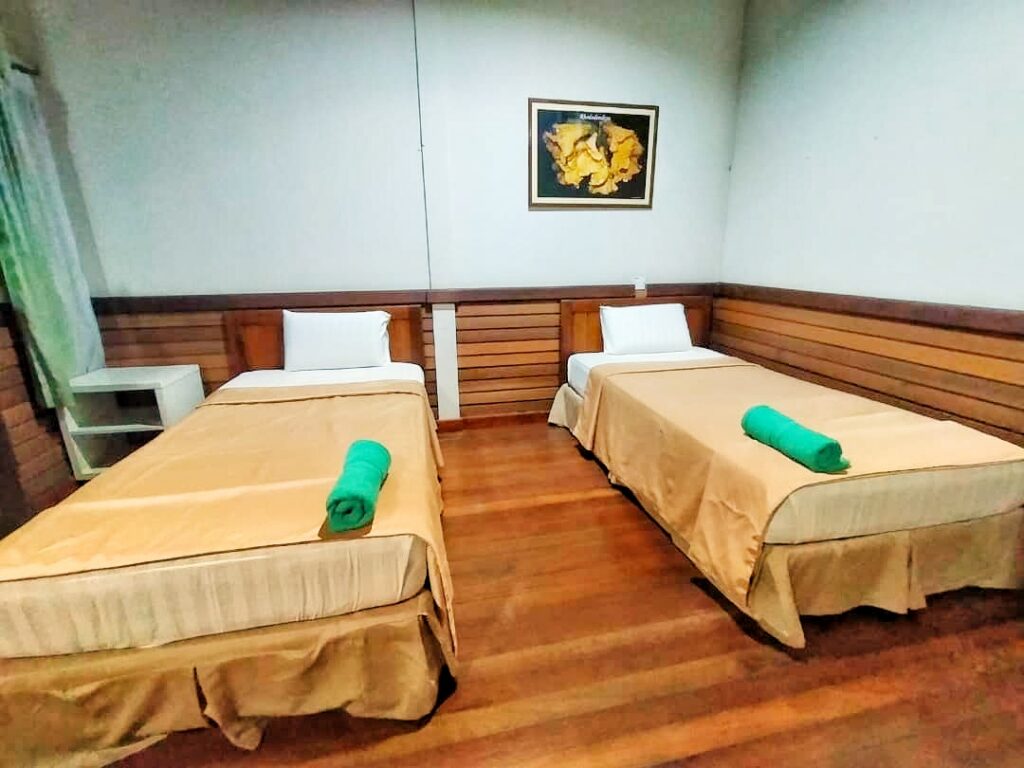 img/trek-camp-bunks.jpgDormitory bunks at an interior camp3/2
Belian Camp
You will see Belian Camp mentioned in Maliau material and it works differently from the interior camps. It sits about 25 kilometres from the security gate and within walking distance of the Studies Centre, so it functions as an outer facility rather than part of the trekking loop. Agathis, Nepenthes and Ginseng are the trekking camps proper.
Leeches
Yes. Leech socks, or football socks as a workable substitute, are on every operator packing list for a reason. They are harmless and they are constant. Bring spares, because wet socks stay wet, and there is nowhere to dry anything.
The full packing list is here, with the reasoning behind each item.
Which Maliau Basin trek should you book?
| 4D3N Trek | 5D4N Trek | |
|---|---|---|
| Nights | 3 | 4 |
| Hardest day | 10 km / ~7 hrs | 9 km |
| Maliau Falls | Through-push | Out and back |
| Giluk Falls | Yes | No |
| Takob Akob Falls | No | Optional |
| Ginseng Falls | Yes | Yes |
| Sky Bridge | No | No |
| Suits | Strong walkers, short on time | Most people |
Note that neither trekking itinerary includes the Sky Bridge or the Observation Tower. Those appear on the Studies Centre packages only. If you want the canopy structures and the interior camps in one trip, you are looking at a longer custom itinerary rather than either standard trek.
Current prices and full inclusions for both treks are on the packages page.
Four packages, Malaysian and international rates side by side, with what each one includes.
Maliau Basin trek questions
How long is the Maliau Basin trek?
Around 32 kilometres of walking across three trekking days on the four-day itinerary, or spread across four days on the five-day version. Individual legs run from 7 to 10 kilometres, each taking roughly five to seven hours including rests.
How difficult is the Maliau Basin trek?
Moderate to hard. The distances are manageable but the terrain is uneven, humidity is constant, there are river crossings, and the days are consecutive with a pack. Operators ask for moderate to good fitness and some require a fitness declaration. The first trekking day, a steep ascent from Agathis to Nepenthes, is rated challenging.
Is the 4D3N trek easier than the 5D4N?
No, it is harder per day. Both cover the same interior but the four-day version compresses it, with a 10 kilometre seven-hour day from Nepenthes over Maliau Falls to Ginseng. The five-day itinerary splits that ground and treats Maliau Falls as an out-and-back.
What are the camps like on the Maliau Basin trek?
Dormitory style, providing a bed and a pillow only. No blanket, no towel, no power and no hot water. Nepenthes Camp sits at 945 metres and Ginseng Camp at 645 metres. Cooks travel with the group and meals are included.
Are there leeches in Maliau Basin?
Yes, and they are constant rather than occasional. Leech socks or football socks appear on every operator packing list. They are harmless. Bring spare socks, because there is nowhere to dry anything.
Do you need a guide for the Maliau Basin trek?
Yes. A registered guide or ranger must accompany every group, and this applies to all trails including the short walks around the Studies Centre. There is no self-guided option anywhere in the conservation area.
Can you see Maliau Falls without trekking?
No. Maliau Falls is only reached on the trekking itineraries. Studies Centre packages do not go far enough into the interior, though they do include the Sky Bridge and Observation Tower, which the treks skip.
How high are the Maliau Basin camps?
Nepenthes Camp, formerly Camel Trophy Camp, sits at 945 metres above sea level. Ginseng Camp is at 645 metres. The 300 metre drop between them is why that leg feels easier than the initial climb from Agathis.
Book a trek that reaches the falls
Tell us your dates and who is coming. You get a day-by-day itinerary, an exact price for your package and rate, and honest advice on which trip fits — including if it is Danum rather than Maliau.